ISIC Harness
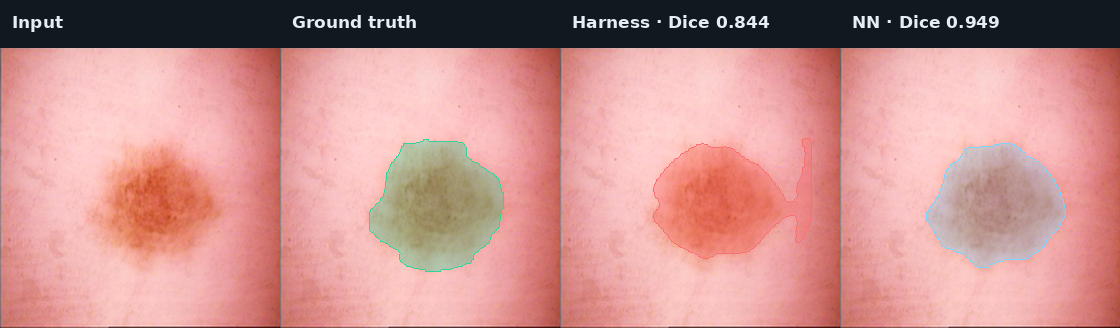
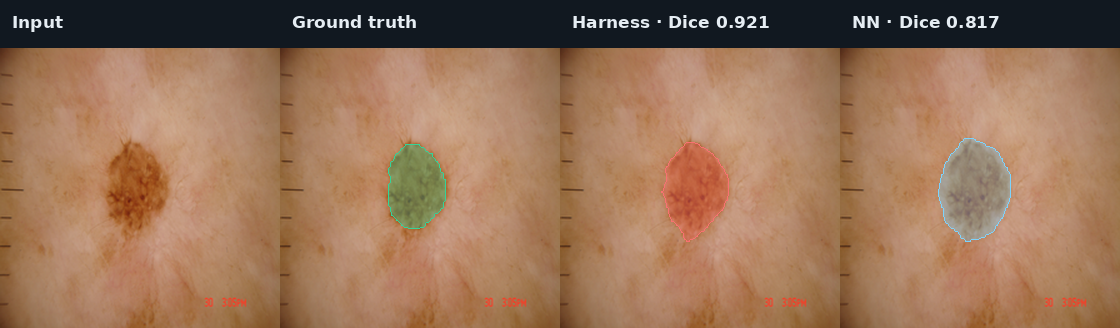
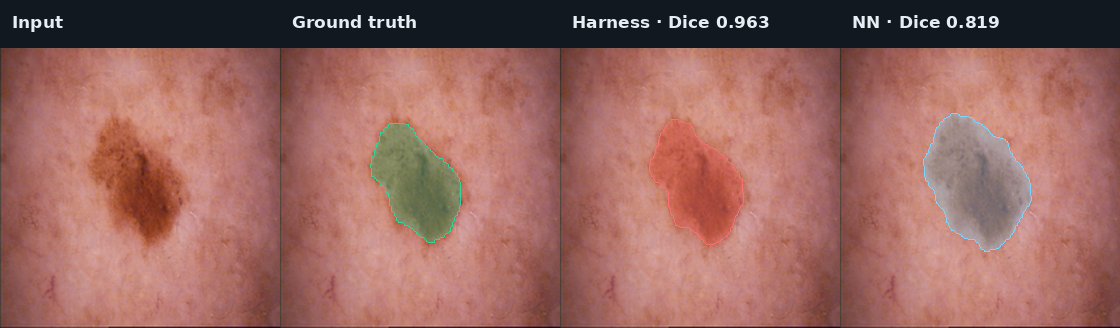
gpt-5.6-sol structured polygon draws followed by the preregistered Support-fit numpy genome. Harness gallery input is the native ISIC image resized with LANCZOS.
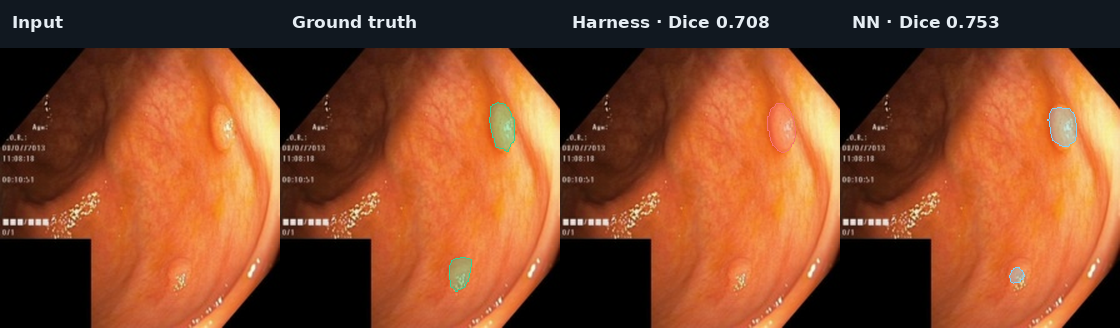
Sealed current-Test scores from the frozen Support-fitted Harness routes, with three fixed-weight NN references for ISIC, Kvasir, CXR, and BUSI. The twelve comparison panels use the same current Test cases for Harness and fixed NN references.
N is the exact number of labeled Support images. All displayed domains keep Support/Test images and groups separate. CXR uses the common overlap-excluded cohort described below. Group-balanced Dice first averages Test images within each group. Harness scores use the sealed Test reports linked below; U-Net and SegFormer use receipted three-seed ensembles; nnU-Net uses its five fixed fold checkpoints. Full precision is retained in the current source JSON and the fixed NN source JSON, with nnU-Net scores and receipts.
| Method | N=10 | N=20 | N=30 | N=40 | N=50 | Test images / groups |
|---|---|---|---|---|---|---|
| Harness · website | 0.866 | 0.864 | 0.865 | 0.868 | 0.871 | 100 / 100 |
| Fixed NN · U-Net | 0.780 | 0.817 | 0.793 | 0.814 | 0.826 | 100 / 100 |
| Fixed NN · SegFormer | 0.777 | 0.836 | 0.845 | 0.845 | 0.859 | 100 / 100 |
| Fixed NN · nnU-Net | 0.750 | 0.836 | 0.835 | 0.832 | 0.846 | 100 / 100 |
| Method | N=10 | N=20 | N=30 | N=40 | N=50 | Test images / groups |
|---|---|---|---|---|---|---|
| Harness · selected decoder Test | 0.779 | 0.799 | 0.822 | 0.810 | 0.817 | 100 / 100 |
| Fixed NN · U-Net | 0.625 | 0.710 | 0.791 | 0.820 | 0.826 | 100 / 100 |
| Fixed NN · SegFormer | 0.694 | 0.721 | 0.831 | 0.851 | 0.861 | 100 / 100 |
| Fixed NN · nnU-Net | 0.598 | 0.647 | 0.683 | 0.728 | 0.757 | 100 / 100 |
| Method | N=10 | N=20 | N=30 | N=40 | N=50 | Test images / groups |
|---|---|---|---|---|---|---|
| Harness · Support-selected | 0.937 | 0.948 | 0.954 | 0.955 | 0.958 | 106 / 106 |
| Fixed NN · U-Net | 0.953 | 0.967 | 0.968 | 0.971 | 0.973 | 106 / 106 |
| Fixed NN · SegFormer | 0.957 | 0.966 | 0.968 | 0.969 | 0.971 | 106 / 106 |
| Fixed NN · nnU-Net | 0.958 | 0.966 | 0.969 | 0.970 | 0.973 | 106 / 106 |
CXR uses the same 106 Test images at every budget and for every method. We excluded all 12 images whose ID or group appears in any of the five Support budgets. NN scores were recomputed from the original per-image results without retraining. Excluded IDs and cohort · Recomputed scores.
| Method | N=11 | N=23 | N=38 | N=49 | N=60 | Test images / groups |
|---|---|---|---|---|---|---|
| Harness · Support-selected | 0.611 | 0.573 | 0.573 | 0.597 | 0.603 | 125 / 100 |
| Fixed NN · U-Net | 0.516 | 0.673 | 0.716 | 0.772 | 0.799 | 125 / 100 |
| Fixed NN · SegFormer | 0.643 | 0.709 | 0.753 | 0.787 | 0.807 | 125 / 100 |
| Fixed NN · nnU-Net | 0.453 | 0.565 | 0.622 | 0.715 | 0.722 | 125 / 100 |
BUSI uses the Support-selected joint image-presence then patch-Ridge method on 11/23/38/49/60 labeled images. The original archive labels these budgets by 10/20/30/40/50 groups; N above denotes images. See the audited sealed Test report for the complete score, prediction-seal, and Support-selection bindings; the gallery case bindings are in the linked manifest below.
adc91bca…; the aggregate receipt is dfb9b5dd….Each four-panel composite uses 50 Support images for ISIC/Kvasir/CXR or 60 for BUSI, with cases selected by quartiles of current Harness Dice after sorting by (Dice, id). The Harness input uses the ISIC native image with LANCZOS or the prepared 224 × 224 view for the other domains; the fixed NN uses the original 224 × 224 BILINEAR terminal view and float32 three-seed probabilities thresholded at 0.5.
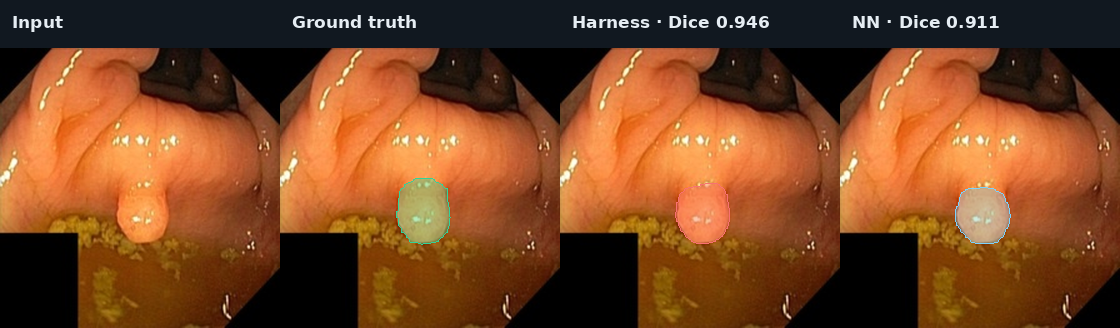
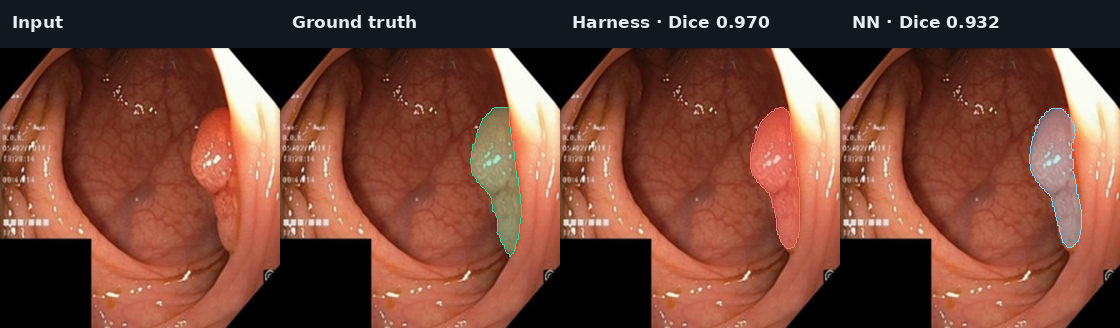
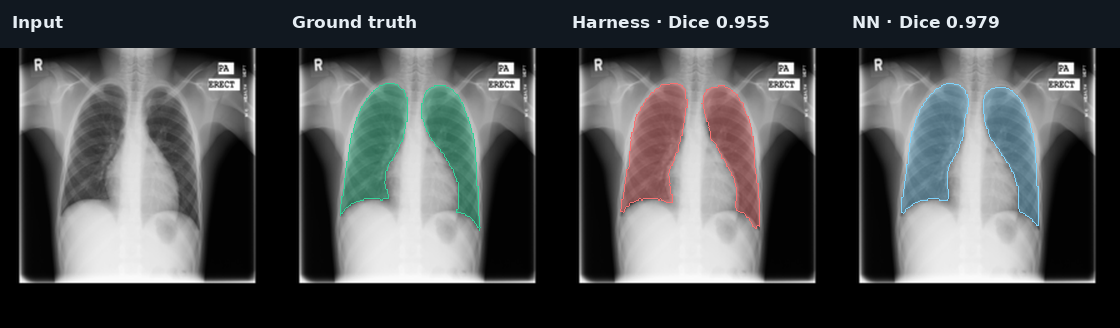
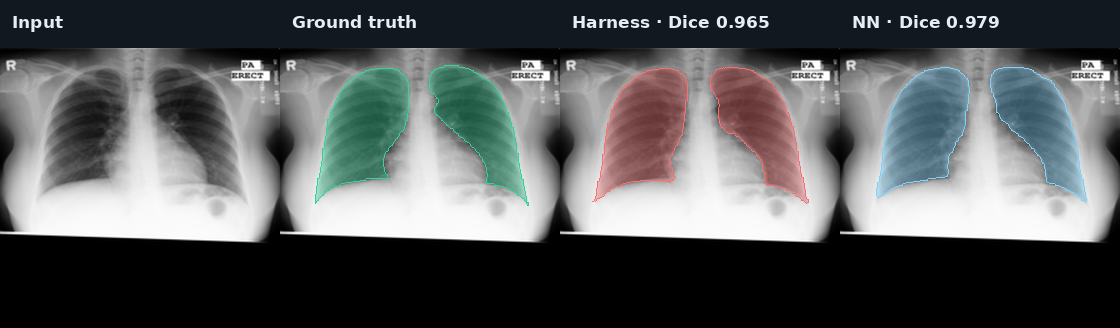
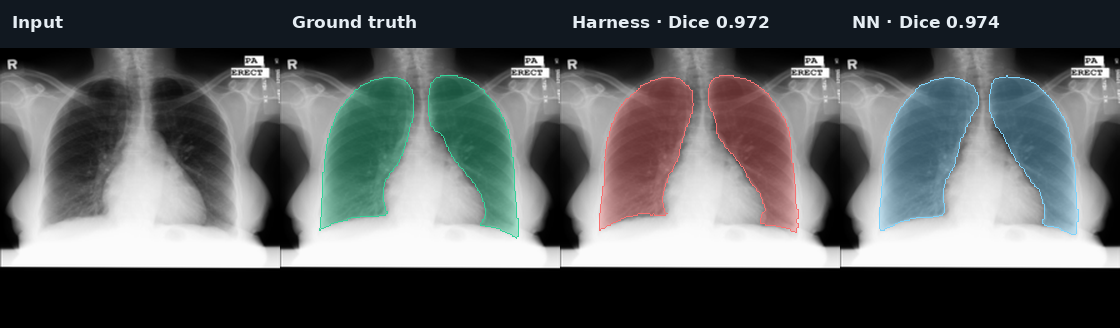
CXR panels are selected from the common Test cohort of 106 images, with no Support ID/group overlap. CXR gallery sources.
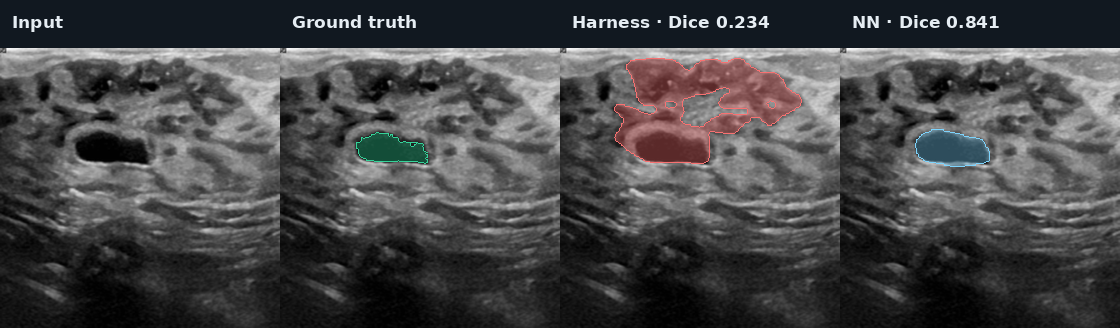
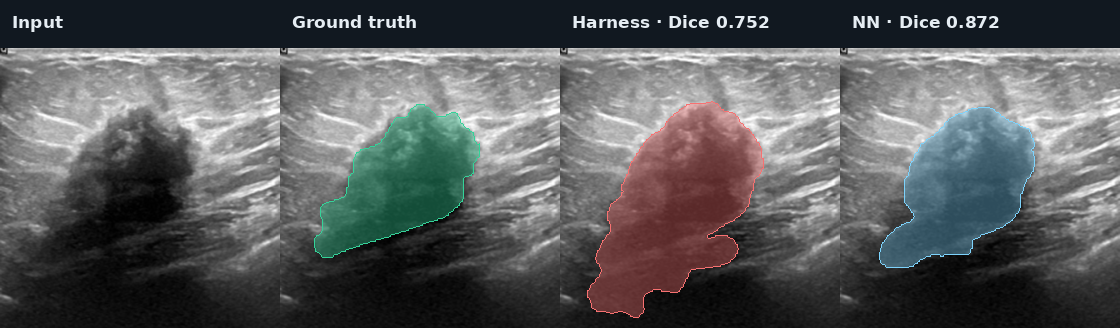
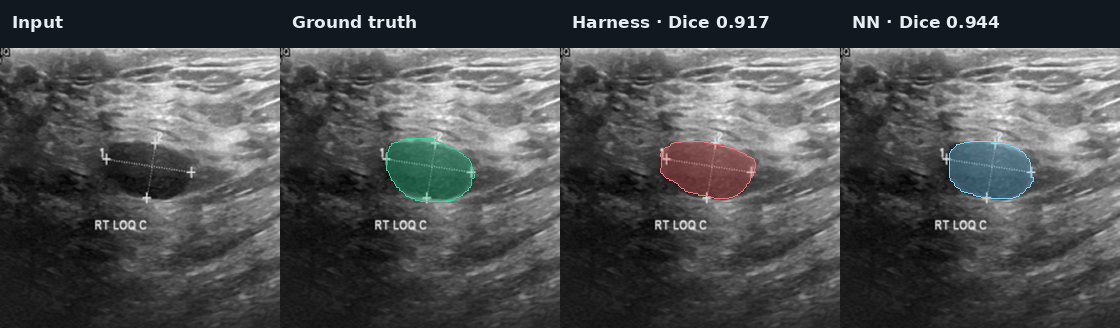
BUSI panels use the same current Test cases for both methods, selected at the lower quartile, median, and upper quartile of Harness Dice. BUSI gallery sources.
gpt-5.6-sol structured polygon draws followed by the preregistered Support-fit numpy genome. Harness gallery input is the native ISIC image resized with LANCZOS.
The independently verified selected decoder is scored on the current 224 × 224 terminal view. HQ is retained at N=10/20/40 and the authenticated SAM2 decoder at N=30/50; the score, prediction, and audit bindings are recorded in the gallery manifest.
U-Net and SegFormer each use three frozen seed checkpoints per N. nnU-Net ensembles five frozen fold checkpoints per N. All scores use current Test cases, without retraining. Each gallery uses the strongest displayed NN family at the largest Support budget: SegFormer for ISIC/Kvasir/BUSI and U-Net for CXR.
The fixed baseline archive is descriptive Test evidence. It is not an adaptation signal. CXR and BUSI use their completed formal Test score receipts.